

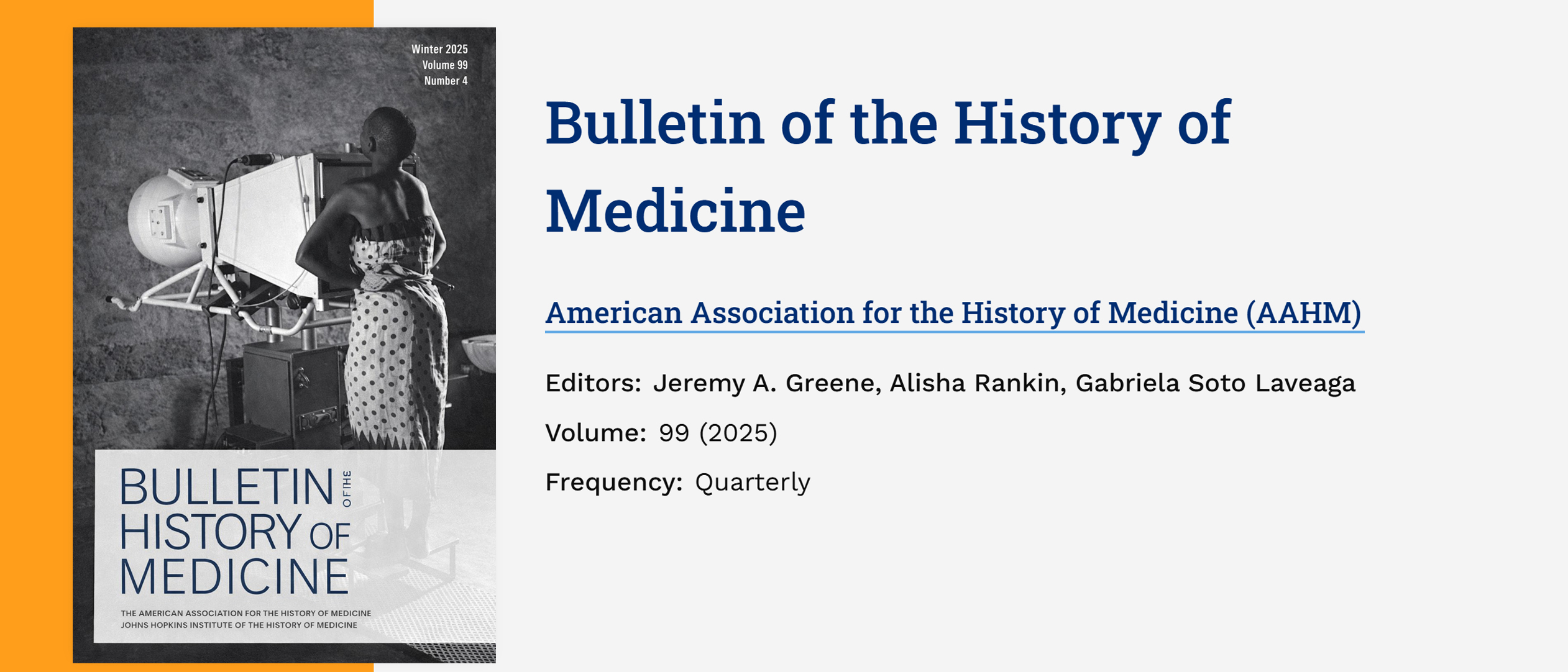


Since 1925, the American Association for the History of Medicine (AAHM) has brought together historians, physicians, nurses, archivists, librarians, and curators who study the medical past. Its work supports research across Arts and Humanities, Medicine, and Nursing. The Association encourages scholarship that traces how ideas about health, illness, and healing have developed over time and how these ideas have shaped public life, scientific practice, and everyday experience. Over decades, this commitment has helped build a global scholarly tradition attentive to cultural contexts, evidence-based research, and methodological diversity.
At the centre of this scholarly activity is the Bulletin of the History of Medicine (BHM), the Association’s journal. BHM has for nearly a century offered a respected, peer-reviewed platform for original research articles, critical essays, and book reviews, supported by a strong citation record reflected in its present Impact Factor of 0.8 and its Five-Year Impact Factor of 1.2. The journal covers the social, cultural, emotional, and scientific dimensions of medical history worldwide. In addition to conventional research papers and reviews, BHM regularly includes sections on digital humanities, pedagogy, and public-history approaches, reflecting its openness to varied methods and contemporary scholarly concerns.
BHM welcomes work on early healing systems, the development of medical theory, the emergence of institutions, public-health responses to crises, the evolution of medical technologies, and the lived experiences of patients and practitioners. Authors may draw on archival records, visual and material sources, scientific texts, oral histories, or comparative studies to chart how medical knowledge was formed and used over time. Your research could explore how medical ideas intersect with societal values, politics, economics, and cultural belief systems, and how these factors shape medical practice and public health across different societies.
The diversity of contributions to BHM is a major strength. Some articles trace the intellectual development of medical theories; others examine relationships between medicine and state power, or between medical authority and the communities it serves. Many discuss the interaction of science, culture, and belief, showing how medical practice has always been shaped not only by laboratories and clinics but by social priorities, moral expectations, and political pressures. Through this variety, BHM serves as a living record of ongoing debates, providing authors with a space to present work that connects past experiences to present concerns in health care and public policy.
For scholars whose work investigates how societies have understood disease and care, how medical knowledge has shifted, or how medical, nursing, and related fields have influenced human experience, BHM offers a credible, long-established platform. Publishing in the journal means contributing to a continuing effort to understand medicine’s past and to show why that history matters for contemporary and future healthcare.